Agency Automation Tools: The Complete Stack for 2026
A practical agency automation stack with tool categories, architecture advice, and the workflows to build first.
Ashar Iftikhar
Author · Operations Specialist
Contents
Implementation note
Ashflow approaches agency automation tools as an operating system problem: map the workflow, simplify the path, connect the tools, add AI where judgment or language is useful, and measure the result.
The agency stack overview
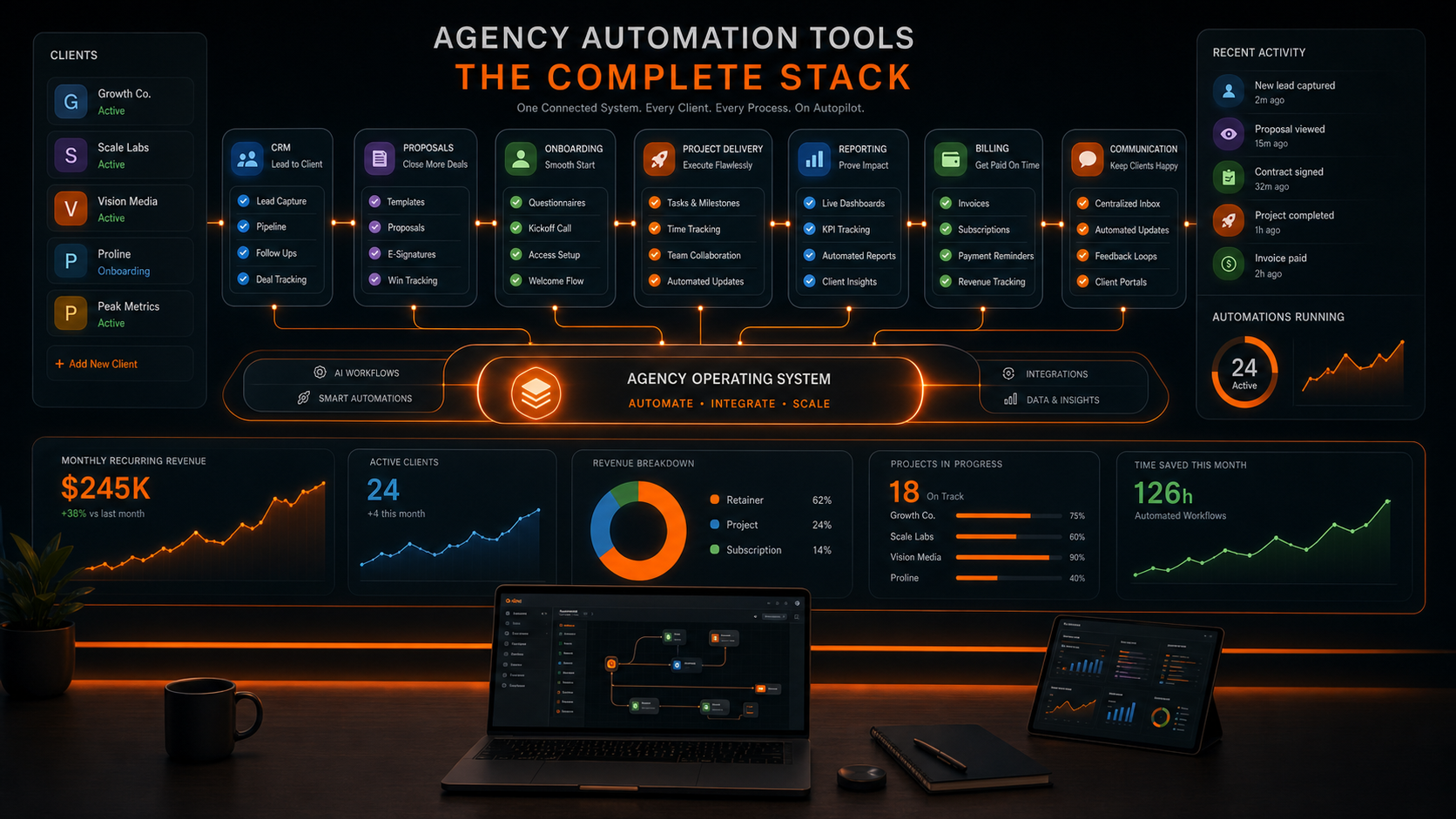
A good agency stack covers CRM, scheduling, proposals, contracts, project management, reporting, communication, and finance.
Automation should connect these layers so one accepted deal creates the next set of actions.
The stack should feel boringly reliable.
Sales and proposal workflows
Lead intake, enrichment, qualification, meeting booking, proposal drafting, e-signature, and invoice creation can be connected end to end.
This shortens the sales cycle and reduces founder admin.
It also makes follow-up consistent.
Delivery workflows
Onboarding forms, kickoff tasks, asset requests, status updates, review cycles, and reporting should be templated.
AI can draft updates and summarize progress, while deterministic workflows move tasks and files.
The combination protects quality.
Mid-article diagnostic
Find the highest-leverage workflow before you build
Ashflow can map the fastest automation opportunity and show where the ROI is most likely to appear first.
Get a 5-Day System PlanReporting and retention
Clients renew when they understand progress and outcomes. Automated reporting keeps value visible.
Dashboards, monthly summaries, and milestone emails should be system-generated with human review.
This turns operations into retention strategy.
When to go custom
Custom systems make sense when the agency has unique delivery logic, high volume, sensitive data, or revenue-critical workflows.
No-code tools are excellent for starting, but custom architecture can become a margin advantage.
The right stack evolves with the agency.
Practical next steps
- List the workflows that repeat every week and touch revenue, customers, inventory, reporting, or finance.
- Score each workflow by time cost, error cost, revenue impact, and ease of automation.
- Pick one workflow, ship a reviewed first version, and measure before expanding the system.
Want the Ashflow version of this system?
Book a free market audit and we will identify the highest-leverage automation opportunities inside your current business model.
Get a 5-Day System PlanRelated reading
Frequently Asked Questions
What is the fastest way to start with agency automation tools?
Start with one measurable workflow that touches revenue, customer experience, or recurring admin. Map the current process, simplify it, launch with human review, and measure the before-and-after impact.
How long does an automation project usually take?
A focused first workflow can often launch in two to four weeks. Larger systems that connect CRM, billing, inventory, support, and reporting usually need a phased 60 to 90 day rollout.
How does Ashflow help with agency automation tools: the complete stack for 2026?
Ashflow designs and deploys practical AI business systems around the workflows that already drive your revenue. The process starts with a free market audit, then moves into a scoped system build with measurable operating outcomes.
"Ashflow is founded and led by Ashar Iftikhar, AI Systems Architect for clients across UAE, USA, UK, and Canada. Founder-led delivery, clear ownership, and direct communication throughout the build."
Read Ashar's story →Keep building the system

Let's fill your calendar with booked clients.
Book a free growth audit. We'll map your biggest opportunities and the fastest path to revenue — whether we work together or not.